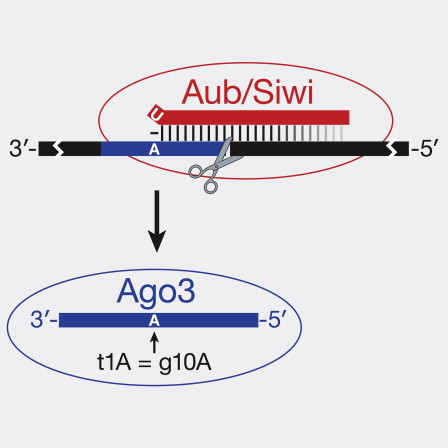
Wang, W., Yoshikawa, M., Han, B.W., Izumi, N., Tomari, Y., Weng, Z., Zamore, P.D. (2014). The Initial Uridine of Primary piRNAs Does Not Create the Tenth Adenine that Is the Hallmark of Secondary piRNAs. Mol. Cell 56(5): 708--716.
FlyBase ID
FBrf0226943
Publication Type
Research paper
Abstract
PIWI-interacting RNAs (piRNAs) silence transposons in animal germ cells. PIWI proteins bind and amplify piRNAs via the "Ping-Pong" pathway. Because PIWI proteins cleave RNAs between target nucleotides t10 and t11-the nucleotides paired to piRNA guide positions g10 and g11-the first ten nucleotides of piRNAs participating in the Ping-Pong amplification cycle are complementary. Drosophila piRNAs bound to the PIWI protein Aubergine typically begin with uridine (1U), while piRNAs bound to Argonaute3, which are produced by Ping-Pong amplification, often have adenine at position 10 (10A). The Ping-Pong model proposes that the 10A is a consequence of 1U. We find that 10A is not caused by 1U. Instead, fly Aubergine as well as its homologs, Siwi in silkmoth and MILI in mice, have an intrinsic preference for adenine at the t1 position of their target RNAs; during Ping-Pong amplification, this t1A subsequently becomes the g10A of a piRNA bound to Argonaute3.