Dmel\P{lacW}domk08108 Insertion
| General Information | |||
|---|---|---|---|
| Symbol | Dmel\P{lacW}domk08108 | Species | D. melanogaster |
| Name | FlyBase ID | FBti0009608 | |
| Feature type | transposable_element_insertion_site | ||
| Description | |||
| Inserted element | P{lacW} | Expression data | |
| Affected gene(s) | dom, Ecol\lacZ | Viability / fertility | |
| Causes allele(s) | domk08108, Ecol\lacZdom-k08108 | Stock availability | 2 publicly available |
| LINE ID | l(2)k08108 | ||
| Genomic Location | |||
| Chromosomal location | 2R ( 57D11 ) | Sequence location | 2R:17,211,119..17,211,119 [+] |
Map (
GBrowse
)
![]() |
|
||
| Member of Large Scale Dataset(s) | |||
| Dataset |
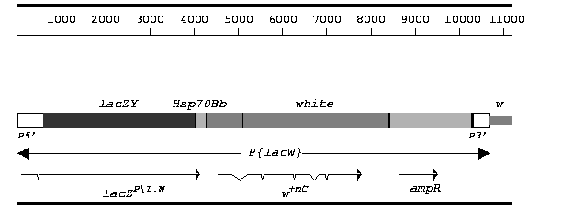
A set of mutant stocks derived by insertional mutagenesis using the P-element construct P{lacW}; most lines have a lethal or sterile phenotype. The P{lacW} construct carries a w[+mC] mini-white visible marker, Ecol\lacZ enhancer trap sequences, and bacterial sequences that allow plasmid rescue (FBrf0049800).
Insertion lines from this collection were assessed for inclusion in the Gene Disruption Project collection.
|
||
Recent Updates
|
|||
| Description |
What does this section display?
This section contains items that were added to this record for each release.
It currently only tracks new links between this FlyBase report and other
FlyBase data classes (e.g. genes, references, stocks) or controlled
vocabulary terms (e.g. GO, anatomy terms).
What does this section not display?
This section does not currently display links that were removed or gene model changes.
|
||
| Update Feed |
Click the icon below to subscribe to this FlyBase record and receive updates automatically through your
feed reader.
|
||
| FB2013_03 | |||
| FB2013_02 | |||
| All updates | Click here to see a list of all updates to this record from FB2010_08 and on. | ||
Detailed Mapping Data
|
|||
| Chromosome (arm) | |||
| Sequence Location |
2R:17,211,119..17,211,119 [+]
|
||
| Orientation | |||
|
Cytological location
(computed by FlyBase) |
57D11 ( inferred by FlyBase from sequence location )
|
||
|
Cytological location
(reported) |
|||
|
Comments concerning
location |
|||
Sequence Data
|
|||
| Flanking sequence | |||
Inserted Element
|
|||
| Construct | P{lacW} | ||
|
Location-dependent
role |
lacZ enhancer trap
|
||
| Size | 10.691Kb | ||
| Associated alleles | |||
| Molecular map |
![]() |
||
Affected Gene(s)
|
|||
|
Insertion may
affect gene |
|||
Alleles and Phenotypes
|
|||
| Causes alleles |
|
||
|
Lethality
References
cell lethal | somatic clone
lethal | pupal stage
lethal | pupal stage | recessive
lethal | recessive
|
|||
|
Sterility
References
female sterile | germline clone | recessive
|
|||
Phenotype Manifest In
|
|||
|
embryonic/larval hemocyte
embryonic/larval lymph gland
follicle stem cell | somatic clone
hemocyte
imaginal disc
imaginal ring
midgut imaginal island
neuroblast
plasmatocyte
prohemocyte
|
|||
Detailed Description
|
|||
|
Statement
Reference
Heterozygosity for dom[k08108] increases the number of wing margin nicks seen in mam[g2.1] heterozygotes.
Heterozygosity for dom[k08108] further reduces the width of N[nd-1] wings.
Wing vein L4 is shortened in N[Ax-E2] mutants; heterozygosity for dom[k08108] slightly increases the length of L4.
Df(2R)ED3921 fails to suppress the melanized lymph gland and lack of hemocyte phenotype of domk08108 mutants .
domk08108 mutants exhibit melanized lymph glands and a lack of hemocytes.
domk08108 homozygous female germ-line stem cells are lost from their stem cell niche at the same rate as wild-type female germ-line
stem cells. However, 91% of dom3 homozygous clone follicle stem cells are lost from their niche within 17 days, compared to only 37.5% of cells in wild-type
control clones. This is not accompanied by any increase in in apoptosis of these cells.
Lethality acts in the early pupal stages. Lymph glands are black, no hemocytes and reduced neuroblast region in the larval
brain. Mititic defects are not evident in the neuroblasts. Females with germline clones do not lay eggs.
Homozygous third instar larvae have a striking absence of circulating hemocytes; only 0 to 10 oversized cells are seen per
larva, in contrast to the wild-type number of 1000-3000 circulating hemocytes. In addition, the number of sessile plasmatocytes
is significantly reduced compared to wild-type.
Homozygous larvae contain large numbers of microorganisms which can be seen on the epithelium lining the integument and on
muscles.
The melanisation in response to pricking with a needle is reduced in intensity compared to wild-type larvae.
Melanisation plaques appear on the surface of homozygous larvae after natural infection by spores of B.bassiana, as are seen in wild-type larvae.
There is not a significant difference in the survival rate between larvae pricked with a sterile needle or a needle coated
with Gram-positive or Gram-negative bacteria, however, infection with fungal spores induces over 60% lethality in 48 hours
in homozygous larvae.
Tl[8]/+ ; dom[k08108], cact[7] dom[k08108] or hop[Tum] ; dom[k08108] double mutant larvae contain melanotic masses, although their frequency is markedly reduced compared to Tl[8]/+, cact[7] or hop[Tum] single mutant larvae and the masses are devoid of hemocytes.
dom[k08108] imd[1] and dom[k08108] Bc[1] double mutant larvae show a dramatically compromised survival after injury (whether it is a clean injury or an injury combined
with infection).
Lethality occurs during third instar larval or pupal stages. Mutants exhibit visible disc abnormalities: very small or no
discs. Clones cannot be induced in wild type discs. In tergites, clones with normal size and but lower than expected frequency
are recovered. Clones cannot be recovered in the wing disc.
Homozygous larvae are totally devoid of circulating hemocytes. In favourable conditions these larvae have a prolonged third
instar, up to 10 days at 20oC. They show melanized lymph glands. During third instar the blackening invades the whole lobe, extending to the posterior
lobes. Melanized lymph glands eventually detach from the dorsal vessel. Ultrastructural analysis reveals that the prohemocytes
in the hematopoetic organ are larger than wild type. Lymph glands are filled with necrotic, melanized cells and cells packed
with heterogeneous inclusions indicative of strong resorptive processes. Mutant glands are devoid of differentiating prohemocytes.
The embryonic hemocytes are unaffected, but by first instar hemocytes are reduced in number. Mutants are also devoid of imaginal
discs, imaginal rings and histoblasts in the gut. The size of the brain is significantly reduced. The domain of brain neuroblasts
in the optic lobes is reduced. Residual imaginal disc cells exist in small clusters.
|
|||
Expression Data
|
|||
| Reporter Expression | |||
| Additional Information | |||
|
Statement
Reference
|
|||
| Marker for | |||
|
Reflects
expression of |
|||
|
Reporter construct
used in assay |
|||
External Images
|
|||
| FlyView (LinkOut) | |||
Data on Genetic Line
|
|||
| Line ID |
l(2)k08108
|
||
| Origin as a multiple insertion line | |||
Progenitor(s) within the Genome
|
|||
Related Aberration or Balancer
|
|||
| Aberration | |||
| Balancer | |||
Stocks
( 2 )
|
|||
| Bloomington | |||
| Kyoto | |||
Linkouts
|
|||
Comments
|
|||
|
Location 2R:16831196-16831197 confirmed by FlyBase alignment of dbGSS accession AQ034011 to D. melanogaster arm Release_4
and heterochromatin Release_3.2b. Insertion orientation confirmed.
|
|||
Synonyms & Secondary IDs
|
|||
| Reported As | |||
| Symbol Synonym |
P{lacW}domk08108
P{lacW}dominok08108
P{lacW}l(2)k08108k08108
|
||
| Secondary FlyBase IDs | |||
|
|||
References
( 17 )
|
|||
| Research paper |
|
||
| Supplementary material |
|
||
| Personal communication to FlyBase |
|
||
| FlyBase analysis |
|
||

Recent Updates