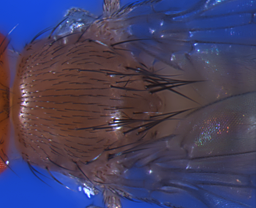
Heterozygotes have many ectopic macrochaetae and microchaetae. Ectopic bristles are particularly seen in the postalar, dorsocentral and scutellar regions of the notum. Tufts of closely spaced or even adjacent bristles are seen. Ectopic bristles are also seen in the anterior-central portion of the scutellum and the metathoracic notum. Ectopic sensory organ precursor cells form in the presumptive posterior notum and scutellum of heterozygous wing discs.
Heterozygotes and homozygotes have extra bristles mainly in the postalar, dorsocentral and scutellar regions of the dorsal mesothorax. Ectopic bristles and other sensory organs are also formed in the metanotum, dorsal to the halteres, in heterozygotes. The extra bristles seen in heterozygotes and homozygotes can develop very close together, forming tufts, and in some cases several tormogens can be fused together. Heterozygotes and homozygotes have a reduced scutellum. The average number of ectopic macrochaetae per heminotum is 23 +/- 3 in heterozygous flies. Ectopic sensory bristles are occasionally seen in the antennae of heterozygous flies, while the arrangement of the olfactory sensilla is essentially normal. A large number of extra sensory organ precursor cells (SOPs) form in the presumptive posterior notum in the wing disc in heterozygotes. These extra SOPs form very close together and their appearance is sequential and occurs concomitantly with the normal SOPs. amosTft embryos show an increase in the number of neurons in the dorsal cluster of the peripheral nervous system. Occasionally the dorsal bipolar neuron is duplicated.
Heterozygotes have an increased number of bristles in the postalar (13-18), dorsocentral (5-10) and scutellar (7-10) regions of the thorax (normal numbers are 4-5, 3-4 and 4-5 respectively).
The total number of bristles on the basitarsi of the second legs is slightly increased.
Extra bristles often very close together; underlying neurons make functional contacts with the CNS (Ghysen and Richelle, 1979). Innervated bristles also found in the metanotum, which has no bristles in wild-type flies (Garcia-Bellido and Deak). Dominant mutation characterized by an increased number of bristles in the postalar, dorsocentral and scutellar regions; tufts of bristles formed on mesothorax in both homo- and heterozygotes; bristles shorter in homozygotes. Extra bristles located dorsal to halteres at junction of thorax and abdomen. Posterior part of mesonotum appears wider than normal. Homo- and heterozygous females have a greatly reduced scutellum; scutoscutellar suture almost absent; heterozygous males have a nearly normal scutellum (Arnheim, 1967). Small to moderate amounts of fluid tend to remain between the epithelial layers of the wing. Penetrance of extra-bristle character 100%. amos not suppressed by Df(1)sc19 but suppressed by Df(1)260-1 (Garcia-Bellido, communicated to Campuzano, Carramolino, Cabrera, Ruiz-Gomez, Villares, Boronat and Modolell, 1985). Cell autonomous in mosaics (Arnheim, 1967). Viability and fertility low.
amosTft has visible | dominant phenotype, suppressible by Df(1)ase-1
amosTft has visible | dominant phenotype, suppressible by Scer\GAL4C-765/E(spl)m8-HLHUAS.cSa
amosTft has visible | dominant phenotype, non-suppressible by Df(1)sc10-1
amosTft/amos[+] is an enhancer of visible | adult stage phenotype of Hsap\MAPTUAS.cWa, Scer\GAL4GMR.PF
amosTft has macrochaeta | ectopic phenotype, enhanceable by Brd[+]/Brd1
amosTft has macrochaeta | ectopic phenotype, enhanceable by DeltaM1/Dl[+]
amosTft has macrochaeta | ectopic phenotype, enhanceable by emc1/emc11
amosTft has macrochaeta | ectopic phenotype, suppressible by da[+]/da10
amosTft has macrochaeta | ectopic phenotype, suppressible by Df(1)ase-1
amosTft has macrochaeta | ectopic phenotype, suppressible by Scer\GAL4C-765/E(spl)m8-HLHUAS.cSa
amosTft has macrochaeta | ectopic phenotype, suppressible by H2/H[+]
amosTft has macrochaeta | ectopic phenotype, suppressible by NAx-M1/N[+]
amosTft has macrochaeta | ectopic phenotype, suppressible by emcD/emcD
amosTft has macrochaeta | ectopic phenotype, non-suppressible by Df(1)sc10-1
amosTft/amos[+] is an enhancer of eye phenotype of Hsap\MAPTUAS.cWa, Scer\GAL4GMR.PF
The amosTft/+ phenotype ectopic bristle phenotype is enhanced by Brd1/+. amosTft is epistatic to Df(1)sc10-1/Y - Df(1)sc10-1/Y ; amosTft/+ flies have ectopic sensory organs in the regions seen in amosTft/+ animals.
The average number of ectopic macrochaetae per heminotum in amosTft/+ flies is increased to 35 +/- 6 if they are also carrying emc1/emc11. The average number of ectopic macrochaetae per heminotum in amosTft/+ flies is increased to 33 +/- 5 if they are also carrying DlM1/+. The average number of ectopic macrochaetae per heminotum in amosTft/+ flies is reduced to 16 +/- 4 if they are also carrying NAx-M1/+. The average number of ectopic macrochaetae per heminotum in amosTft/+ flies is reduced to 19 +/- 2 if they are also carrying H2/+. The average number of ectopic macrochaetae per heminotum in amosTft/+ flies is reduced to 6 +/- 2 if they are also expressing E(spl)Scer\UAS.cSa under the control of Scer\GAL4C-765. The average number of ectopic macrochaetae per heminotum in amosTft/+ flies is reduced to 4 +/- 2 if they are also carrying emcD/emcD. The ectopic microchaetae seen on the scutellum in h1 flies are suppressed by amosTft. The tufts of ectopic bristles on the notum that are seen in amosTft/+ flies are suppressed by Df(1)ase-1, but are unaffected by Df(1)sc10-1.